If you’ve ever stood in the oral-care aisle staring at two nearly identical green bottles — both promising to kill bad breath at the source — you know the paralysis. TheraBreath and SmartMouth are the two brands that reliably come up whenever someone wants more than a mint or an alcohol-based swish. Both lean on zinc, a naturally occurring mineral that neutralizes the sulfur compounds bacteria in your mouth produce. Both are alcohol-free, which matters because alcohol-based rinses temporarily mask odor while drying out your mouth and potentially making the underlying problem worse. And both cost roughly $10–$18 for a standard bottle — premium compared to drugstore generics, but not extravagant. So why does it matter which one you buy? Because the ingredient panels are genuinely different, and those differences determine whether you get four hours of coverage or twelve, and whether the formula addresses only odor or also bacterial load. This article breaks that down in plain terms.
| EDITOR'S PICK[SmartMouth Original Zinc Activa…](https://www.amazon.com/dp/B00J7G0K9O?tag=greenflower20-20) | Mid-tier[TheraBreath Fresh Breath Mouthw…](https://www.amazon.com/dp/B001ET76AI?tag=greenflower20-20) | Budget pick[Listerine Cool Mint Alcohol-Fre…](https://www.amazon.com/dp/B0D14XZX6V?tag=greenflower20-20) | |
|---|---|---|---|
| Size | 16 fl oz | 16 fl oz (2-Pack) | 1 L |
| Active Ingredient | Zinc | — | — |
| Flavor | Fresh Mint | Mild Mint | Mild Mint |
| Price | $19.68 | $15.34 | $7.00 |
| See on Amazon → | See on Amazon → | See on Amazon → |
The Core Chemistry: What Zinc Actually Does (and What It Doesn’t)
Let’s start with the science, kept short. Your mouth is home to hundreds of bacterial species. Some of them digest proteins and release VSCs — volatile sulfur compounds — as a byproduct. VSCs are what you smell. Hydrogen sulfide, methyl mercaptan: these are the molecules behind the experience of bad breath. Zinc ions bind to sulfur molecules directly, deactivating them chemically before they volatilize into your exhaled air. That’s neutralization, not masking.
This mechanism is well-documented. The National Institutes of Health Office of Dietary Supplements, in its Zinc Fact Sheet for Health Professionals, describes zinc’s established antimicrobial properties and notes its study in the context of oral malodor. Healthline’s editorial coverage of bad breath causes and treatments lists zinc-based rinses among evidence-backed interventions that address VSC production at the source rather than covering it with fragrance. The American Dental Association’s Oral Health Topic on mouthrinses acknowledges that zinc-containing rinses can reduce volatile sulfur compounds, while noting that efficacy varies by formulation and use pattern.
Here’s the decision-frame point: not all zinc is the same in a rinse. The specific zinc compound used, its concentration, and what it’s paired with determines how effectively it’s delivered into the oral biofilm — the thin layer of bacteria coating teeth, gums, and tongue. This is where TheraBreath and SmartMouth diverge.
TheraBreath vs SmartMouth: A Formulation-by-Formulation Comparison
H3: TheraBreath — Fast-Onset OXYD-8 Chemistry
TheraBreath’s signature is OXYD-8, a stabilized chlorine dioxide compound that the brand developed as its primary active agent. Chlorine dioxide is an oxidizer — it breaks down VSCs chemically on contact. Zinc (in the form of zinc gluconate) is present in TheraBreath’s clinical-line formulas as a secondary active, extending the effect after the initial oxidizing burst.
The practical implication: TheraBreath tends to work fast. Reviewers across aggregated sources consistently describe an immediate freshness that’s noticeably stronger in the first 30–60 minutes after rinsing. The reported trade-off is a shorter effect window — typically three to five hours — before a meaningful portion of VSC suppression fades.
TheraBreath’s standard formulation is notably simple. The ingredient list is short, alcohol-free, and free of artificial flavors in the clinical line. For ingredient-conscious buyers, that simplicity is genuinely appealing: fewer unknowns, easier to evaluate, nothing that reads like it was added to extend shelf life at the expense of your oral microbiome.
At a glance:
| Metric | TheraBreath Fresh Breath (standard) |
|---|---|
| Typical retail price (May 2026) | $11–$14 / 16 oz |
| Cost per 10 mL rinse | ~$0.07–$0.09 |
| Reported coverage window | 3–6 hours |
| Primary active | Stabilized chlorine dioxide (OXYD-8) |
| Zinc compound | Zinc gluconate (secondary) |
| Alcohol | No |
TheraBreath
$15.34
In stock on Amazon
Check price on AmazonH3: SmartMouth — Two-Part Zinc Ion Architecture
SmartMouth takes a structurally different approach that’s worth understanding, because it’s more unusual than the label suggests at a glance. The product ships as a two-bottle system: one bottle contains a zinc solution, the other a sulfur-blocker activator. You combine them in the cap immediately before rinsing. The chemistry here is that active zinc ions (Zn²⁺) are unstable in most aqueous solutions — they bond with other ingredients and lose potency over time. By keeping the zinc precursor and the activator separate until the moment of use, SmartMouth delivers significantly higher concentrations of active zinc ions than a pre-mixed formula can sustain.
WebMD’s overview of mouthwash types and benefits notes that some dual-component rinse systems are specifically designed to address the stability challenges of active ingredients in solution — SmartMouth’s two-bottle architecture is a direct application of that problem.
The practical implication: reviewers who use SmartMouth consistently report a longer coverage window, frequently citing 12 hours as a realistic result for moderate cases of halitosis — the clinical term for chronic bad breath. This aligns with the brand’s own “12-hour” marketing claim, which appears to hold up in aggregated consumer experience rather than just ad copy. Examine.com’s evidence summary on zinc notes that sustained zinc ion availability is a key variable in how long VSC suppression holds, supporting the rationale behind SmartMouth’s delivery architecture.
The trade-offs: the two-bottle system is slightly more cumbersome. You need both bottles accessible. If you travel, you’re managing two containers instead of one. The immediate-use experience in the first 15 minutes gets more mixed reviews than TheraBreath — the oxidizing hit of OXYD-8 is a more perceptible sensation that some users interpret as “working,” even though sensation does not equal efficacy. SmartMouth’s action is quieter but, based on published usage reports, more durable.
At a glance:
| Metric | SmartMouth Activated |
|---|---|
| Typical retail price (May 2026) | $14–$18 / dual-bottle system |
| Cost per 10 mL rinse (combined) | ~$0.10–$0.13 |
| Reported coverage window | 8–12 hours |
| Primary active | Active zinc ions (Zn²⁺) via dual-activator system |
| Alcohol | No |
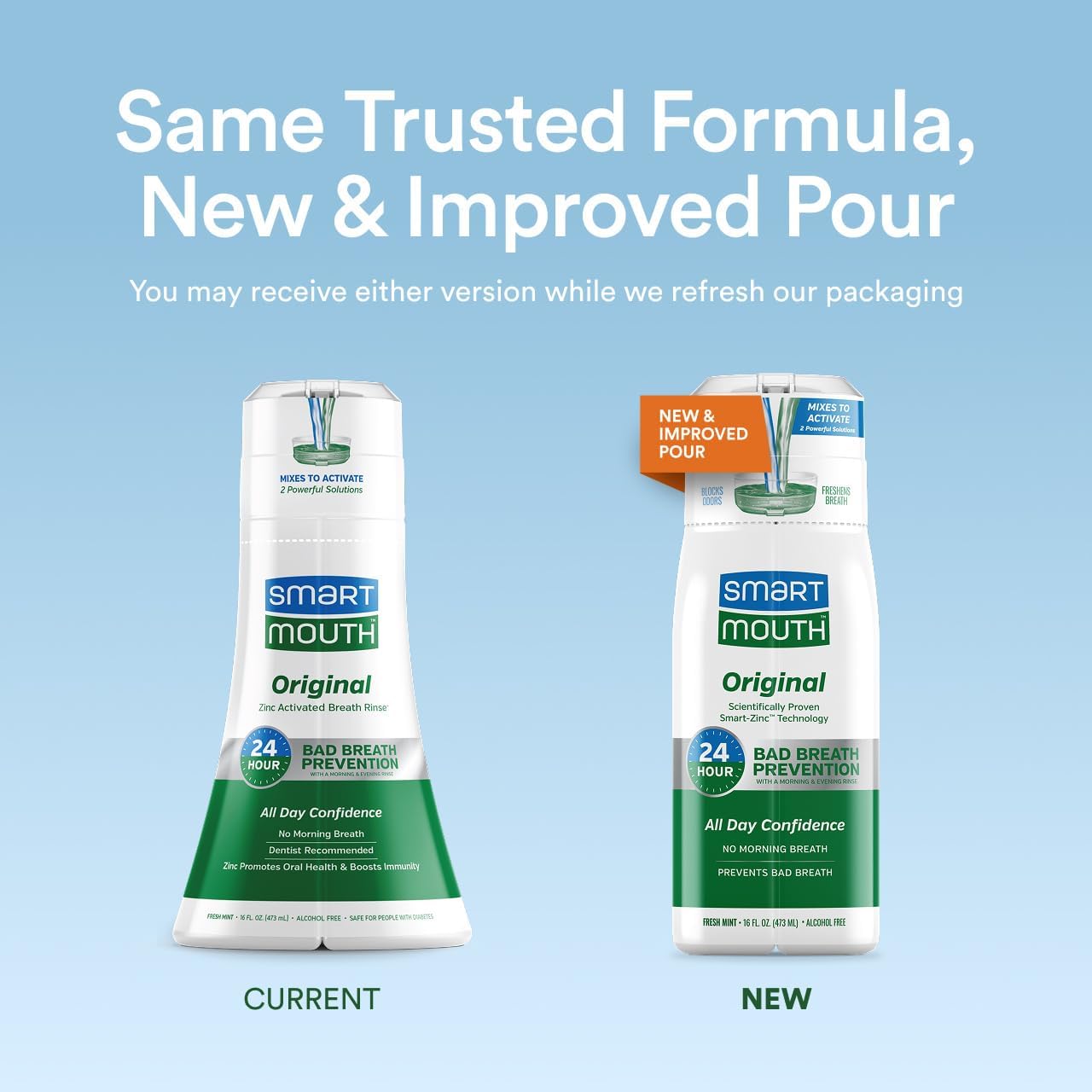
SmartMouth
$19.68
In stock on Amazon
Check price on AmazonH3: Reading the Label — The Three Signals That Actually Matter
You don’t need a chemistry degree to evaluate a mouthwash ingredient panel. Here are the three signals worth finding before you commit to a bottle.
1. Which zinc compound? Zinc gluconate, zinc acetate, and zinc chloride are the most common forms. Zinc gluconate — TheraBreath’s choice — is gentler and well-tolerated. Zinc chloride delivers higher ion concentration but can be harsher at elevated doses. SmartMouth uses a zinc chloride-based precursor that the dual-activation system keeps at effective levels without exposing the mouth to direct high-concentration zinc chloride. Mayo Clinic’s published guidance on bad breath diagnosis and treatment acknowledges that zinc-containing rinses vary in tolerability and that some users experience taste distortion with certain zinc salts — a real-world note worth considering if you’re sensitive to metallic tastes.
2. Is there a secondary antibacterial? Zinc neutralizes VSCs but doesn’t kill bacteria on its own. Some formulas pair zinc with CPC — cetylpyridinium chloride, a quaternary ammonium compound that disrupts bacterial cell membranes. Neither TheraBreath’s standard formula nor SmartMouth’s core formula relies primarily on CPC, though variants exist within each brand’s product line. If bacterial reduction (not just VSC suppression) is your goal, look for CPC or chlorhexidine (prescription-strength, commonly used for gum disease) on the label.
3. Is alcohol present? Both TheraBreath and SmartMouth are alcohol-free in their primary formulas. Healthline’s editorial coverage of bad breath causes explains that alcohol-containing rinses cause dry mouth (xerostomia), which paradoxically increases VSC production — the opposite of what you want. If a competing brand’s label lists “SD alcohol” or “ethanol” in the active ingredient block, that’s a masking product, not a treatment.
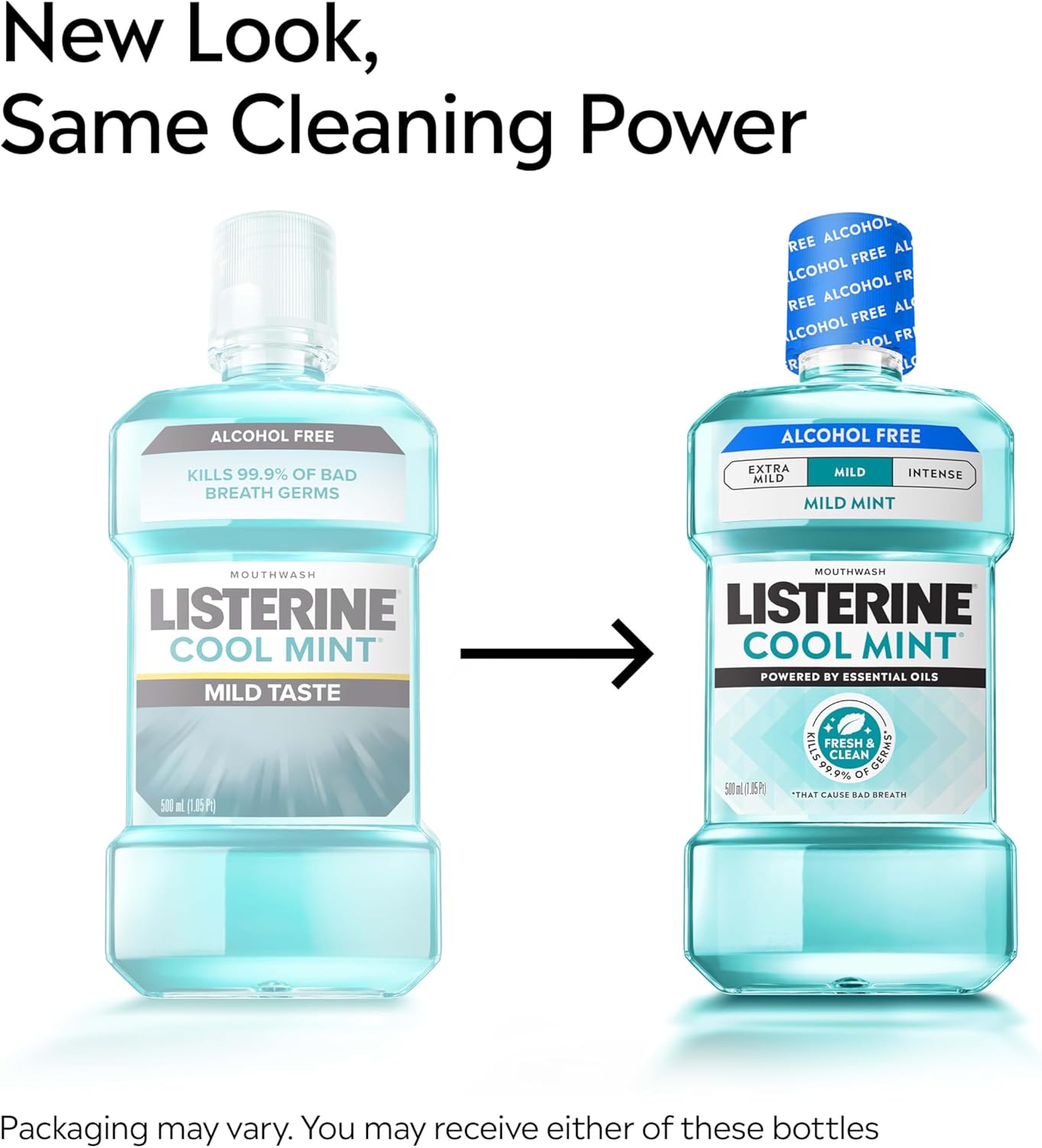
Listerine
$7.00
In stock on Amazon
Check price on AmazonThe Decision Frame: Which One Is Actually Right for You?
Here’s the honest if/then breakdown based on published specifications, aggregated reviewer patterns, and ingredient analysis:
If your main concern is social situations with a defined endpoint — a meeting, a date, a presentation — and you want the strongest immediate-onset effect, TheraBreath’s OXYD-8 formulation delivers a noticeable, fast-acting result at a lower per-use cost. The shorter coverage window is a non-issue when you can re-rinse beforehand.
If you’re dealing with chronic morning breath or all-day freshness as a goal, SmartMouth’s ion-delivery architecture is the better match. The 12-hour coverage window, consistently reported across long-run user reviews, means a morning rinse carries you through a full workday without a midday re-application. The slightly higher cost per use — roughly $0.03–$0.05 more per rinse — is modest against that convenience.
If you have a sensitive palate or known zinc salt sensitivity, TheraBreath’s zinc gluconate base has a milder profile. Start there and assess tolerance before moving to a higher-concentration zinc system.
If you’re building a layered oral-care routine — tongue scraping, oral probiotics, consistent flossing — SmartMouth’s longer window reduces redundancy in your stack. You’re not re-rinsing to plug a coverage gap; the zinc continues working while your other interventions do their part. For buyers investing in a broader oral microbiome protocol, better zinc coverage per application is a meaningful stack optimization.
If ingredient simplicity is a priority, TheraBreath’s shorter ingredient list is the cleaner choice. Fewer compounds, easier to audit, nothing unexpected.
Where Both Products Fit — and Where They Don’t
Neither TheraBreath nor SmartMouth is a substitute for a dentist visit if you’re experiencing persistent halitosis. Mayo Clinic’s diagnostic guidance on bad breath is explicit: chronic cases often trace to gum disease, tooth decay, dry mouth conditions, or systemic issues that no rinse will resolve. Both products are best understood as daily-maintenance tools for normal oral odor management — not treatments for underlying pathology.
Within that scope, both are genuinely among the better options on the market. The zinc mouthwash category has real science behind it, and both brands have earned their shelf space through consistent performance data. The American Dental Association’s Oral Health Topic on mouthrinses provides a useful baseline: look for products with documented active ingredients, avoid relying on alcohol-based rinses as a primary strategy, and match the formula architecture to your coverage needs.
The ingredient panel tells you which one’s design fits your situation. Now you can read it.
Merchants of Breath editorial analysis is based on published product specifications, named-source research on active ingredients, and aggregated consumer reviewer data. Plain-text citations reference the following sources: National Institutes of Health Office of Dietary Supplements — Zinc Fact Sheet for Health Professionals; Healthline — What Causes Bad Breath and How to Treat It; Mayo Clinic — Bad breath: Diagnosis and treatment; American Dental Association — Mouthwash (Mouthrinse) Oral Health Topic; Examine.com — Zinc: Evidence Summary; WebMD — Mouthwash: Benefits, Types, and How to Use It. No products were tested or owned by the editorial team.