You’ve probably heard that your gut has a microbiome — a community of bacteria that affects digestion, immunity, and even mood. Your mouth has one too. The oral microbiome is the ecosystem of bacteria, fungi, and other microorganisms that live on your tongue, gums, and throat lining. When that ecosystem tips out of balance — too many odor-producing or acid-generating bacteria, not enough protective ones — you get bad breath, bleeding gums, or recurring throat irritation, no matter how often you brush. An oral probiotic is a supplement designed to introduce beneficial bacteria directly into your mouth (usually via a slow-dissolving lozenge or chewable tablet) to help crowd out the troublemakers. This guide focuses on two specific bacterial strains — BLIS K12 and BLIS M18 — that dominate the premium end of this category, explains what each one actually does, and gives you a clear decision framework for choosing between them.
What BLIS K12 and M18 Actually Are (and Why Strain Identity Matters)
Both strains are proprietary, trademarked versions of a bacterium called Streptococcus salivarius — a species that naturally colonizes healthy human mouths and throats. The “BLIS” acronym stands for Bacteriocin-Like Inhibitory Substances, which is just a scientific way of saying these bacteria produce compounds that suppress competing, harmful bacteria. The strains were isolated and developed by BLIS Technologies Ltd., a New Zealand biotech company whose research is some of the most cited in the oral probiotic literature.
Here’s the critical concept most shoppers miss: strain identity is everything in probiotics. Saying “I take Streptococcus salivarius” is like saying “I drive a car.” K12 and M18 are different vehicles with different destinations. They were selected from thousands of human samples for different functional properties, and the clinical evidence behind each strain applies only to that specific strain — not to generic S. salivarius products.
By the numbers:
| Strain | Primary target | Typical CFU dose | Key mechanism |
|---|---|---|---|
| BLIS K12 | Bad breath, throat / ear health | 1–2 billion CFU | Produces salivaricin A2 and B; competes with odor-causing pathogens |
| BLIS M18 | Gum health, tooth decay risk | 1–2 billion CFU | Produces salivaricin 9; reduces Streptococcus mutans (the main cavity-causing bacteria) |
CFU stands for Colony Forming Units — it’s the standard way to count living bacteria in a probiotic dose. Higher isn’t automatically better; delivery format and strain viability matter more.
BLIS K12: The Breath and Throat Strain
If your primary frustration is persistent bad breath that survives brushing and flossing, or if you get frequent sore throats and ear infections (or have kids who do), K12 is the strain with the most directly relevant research.
How it works: K12 colonizes the back of the throat and the tonsillar crypts — those small pockets in your tonsils where odor-causing bacteria and biofilm tend to accumulate. Once established, K12 bacteria produce antimicrobial compounds (salivaricins) that physically suppress Streptococcus pyogenes (the bacteria behind strep throat) and several Gram-negative anaerobes responsible for volatile sulfur compounds (VSCs) — the technical name for the sulfur-based gases that produce that classic “rotten egg” bad breath odor.
Research indexed in NCBI’s PubMed database, including studies sponsored or cited by BLIS Technologies, shows that K12 supplementation can meaningfully reduce VSC levels in subjects with chronic halitosis (the clinical term for persistent bad breath). Healthline’s overview of oral probiotics references this body of work and notes that K12 is currently the most evidence-supported strain for breath-specific outcomes.
The delivery format catch: K12 must dissolve slowly in the mouth and throat — not in your stomach. This is why genuine K12 products come as slow-dissolve lozenges, not swallowed capsules. If you see K12 in a standard swallowed pill, the bacteria are likely dying in stomach acid before they reach your mouth tissue. This is a label-reading skill worth developing: look for “slow dissolve,” “melt tablet,” or “buccal” (meaning mouth-absorbed) on the packaging.
Who should prioritize K12:
- Chronic bad breath that persists despite good brushing habits
- History of recurring strep or tonsil issues
- Anyone who’s had their tonsils removed (the throat microbiome is often disrupted)
- Parents looking to reduce their children’s strep exposure (pediatric K12 research exists)
Popular K12 products reviewed favorably by users and formulation researchers include Hyperbiotics PRO-Dental, which discloses K12 CFU counts and uses a slow-release BIO-tract tablet. The examine.com overview of S. salivarius confirms that the existing human trials on K12 show a meaningful (if not universal) reduction in both breath scores and strep colonization rates.
BLIS M18: The Gum and Cavity Strain
M18 targets a different part of the mouth — primarily the gumline, tooth surfaces, and the plaque biofilm that forms there. Its main adversary is Streptococcus mutans, the bacterium most implicated in dental cavities, and the anaerobic bacteria associated with early-stage gum disease (gingivitis — meaning inflammation of the gums).
How it works: M18 competes with S. mutans for adhesion sites on your teeth and produces enzymes that break down dental plaque’s structural sugars. Less plaque surface area means fewer places for acid-producing cavity bacteria to establish themselves. BLIS Technologies’ own clinical summary documents describe M18 as producing urease and dextranase — enzymes that raise local pH (neutralize acid) around teeth and degrade the sticky polysaccharide matrix that holds plaque together.
The mindbodygreen roundup of oral probiotics, which consulted dental professionals, notes that M18 is specifically mentioned by holistic dentists as a complementary tool for patients managing early gingivitis or elevated cavity risk — not a replacement for professional cleaning, but a meaningful adjunct.
The honest caveat: M18 research is strong but slightly smaller in volume than K12’s. Most of the published human trials come from New Zealand and India and involve relatively small sample sizes. The direction of evidence is positive, but it’s worth keeping expectations calibrated: M18 is a support strategy, not a miracle. Per the Healthline review of oral probiotics, clinical outcomes for gum metrics (like bleeding-on-probing scores) show improvement over 3–6 month protocols, not weeks.
Who should prioritize M18:
- Active or recent gingivitis diagnosis
- Dentist has flagged elevated plaque scores
- History of cavities despite regular brushing
- Anyone in orthodontic treatment (braces create plaque traps)
The Combination Question: Do You Need Both?
Several products on the market now combine K12 and M18 in a single lozenge. This makes intuitive sense — breath health and gum health aren’t entirely separate systems — and formulation researchers generally view the combination as complementary rather than redundant.
The tradeoff is straightforward: combination products often cost more per serving, and if your issue is clearly one-sided (pure breath problem vs. pure gum concern), you might achieve better results and lower cost by picking the single-strain option that matches your need.
Here’s the decision rule laid out plainly:
- If X = bad breath is your main complaint → prioritize a K12-only or K12-dominant slow-dissolve lozenge. Build the habit for 90 days before evaluating.
- If X = gum bleeding, elevated plaque, or cavity history → prioritize M18, ideally alongside your existing flossing routine.
- If X = both, or you want a baseline oral health protocol → a combination product is a reasonable starting point and reduces the number of supplements you’re managing.
- If X = budget is tight → K12 tends to have slightly more formulation options at lower price points. M18 combination products trend toward the $25–$45 range for a 30–60 day supply.
How to Read an Oral Probiotic Label (The 3-Minute Version)
This is where most shoppers get lost — and where premium brands earn their premium by being transparent.
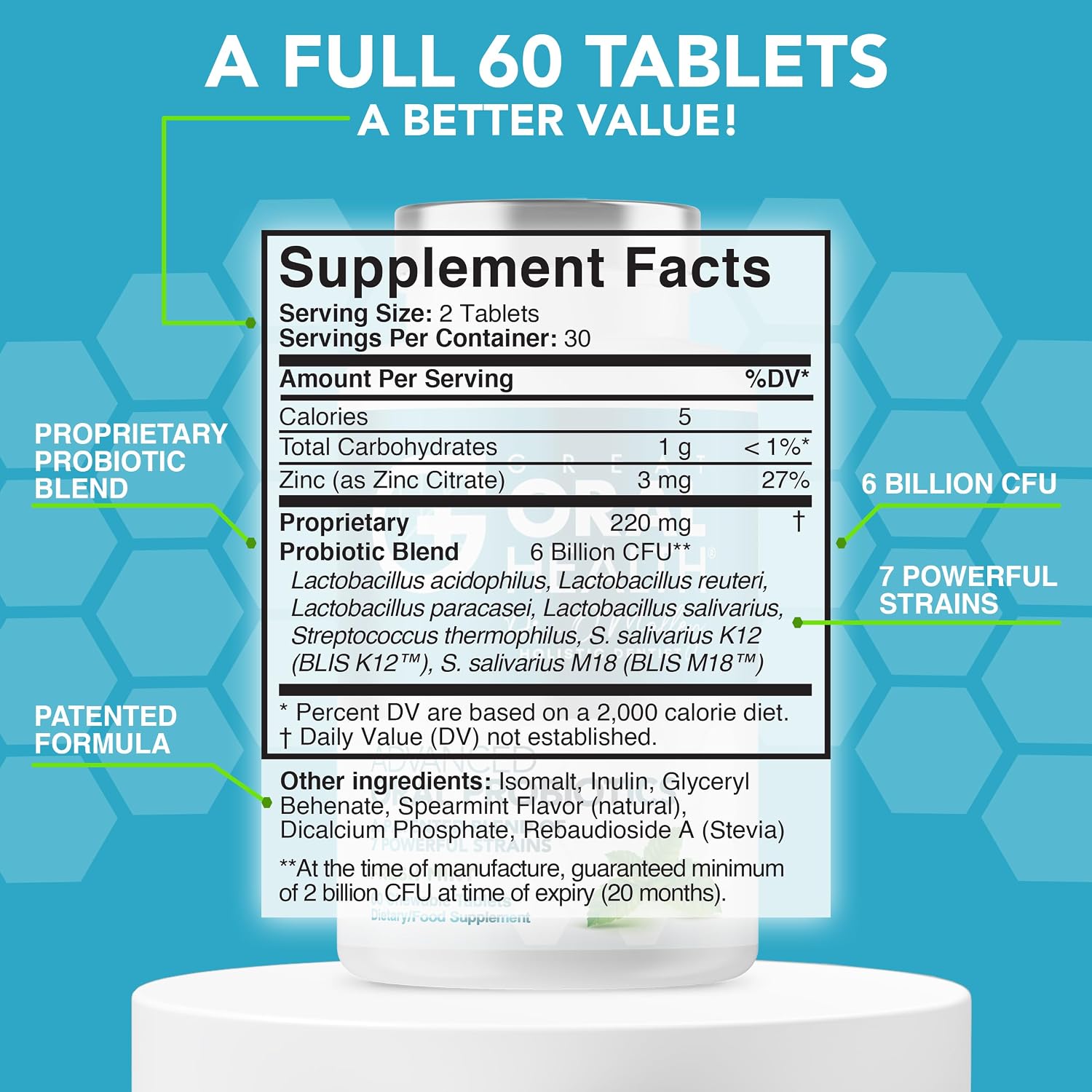
1. Strain disclosure. The label must name the strain by full identity, not just the species. “BLIS K12” or “Streptococcus salivarius K12” is what you’re looking for. Generic “Lactobacillus blend” or unnamed S. salivarius tells you nothing useful.
2. CFU count at time of expiry, not manufacture. Bacteria die over time. A label that says “2 billion CFU at time of manufacture” might deliver far fewer viable bacteria by the time you open the bottle. Look for “guaranteed through expiry” or “at expiry date” language. Hyperbiotics, for example, discloses viability benchmarks explicitly in their product documentation.
3. Delivery format match. As covered above: oral probiotics need buccal (mouth) or throat delivery. Slow-dissolve lozenges, chewables, or melt tablets. Not swallowed capsules.
4. Storage requirements. Some oral probiotic formulations require refrigeration; some are shelf-stable. This isn’t a quality signal either way — it’s just a logistics factor. Check before you order a three-month supply if you travel frequently.
5. Artificial sweeteners. Many lozenge formats use xylitol (actually beneficial for oral health, per American Dental Association guidance), sorbitol, or maltodextrin. Xylitol is the one to look for; it has an independent anti-cavity effect. Avoid products where sugar or corn syrup appears in the first few ingredients — it’s counterproductive in an oral health product.
The Honest Bottom Line
Oral probiotics aren’t magic, and they’re not a replacement for mechanical cleaning — brushing, flossing, and tongue scraping still do work that no bacteria can replicate. What K12 and M18 offer is something genuinely different: a way to shift who is living in your mouth, not just temporarily suppress or mask the bacteria causing problems.
The research, reviewed across NCBI’s PubMed database, examine.com’s strain summary, and clinical documents from BLIS Technologies, consistently points to a 60–90 day minimum commitment before colonization stabilizes and measurable outcomes appear. This is a slow-burn investment, not a quick fix — which is why it appeals to the same audience that tracks sleep scores and reads ingredient labels.
If you’ve already optimized your brushing technique, added a tongue scraper, and you’re still not where you want to be, a properly formulated oral probiotic — strain-identified, slow-dissolve, with a disclosed CFU guarantee — is one of the most logical next steps in the breath-care stack.
Pick the strain that matches your problem. Give it 90 days. Read the label before you buy.