If you’ve ever stood in the oral-care aisle genuinely confused about why one mouthwash costs $4 and the next one costs $22, you’re not alone — and you’re asking exactly the right question. Mouthwash (a liquid rinse you swish around your mouth for 30–60 seconds to kill bacteria, freshen breath, or both) is one of those everyday products where price and performance have almost no reliable relationship on the shelf label. The alcohol-heavy budget bottle might actually irritate your mouth. The clinical-grade premium rinse might deliver twice as many uses per bottle. And the mid-range option sitting between them might be doing something entirely different at the chemistry level. This guide breaks down three of the most-purchased mouthwashes — Listerine Cool Mint, TheraBreath Fresh Breath Oral Rinse, and CloSYS Original Unflavored — by what they actually do, what they actually cost per rinse, and which one belongs in your routine given your specific situation. No sales pitch. Just the math, the ingredient logic, and a clear decision framework at the end.
What You’re Actually Buying: The Ingredient Story
Before the price table means anything, you need to understand that these three products are not doing the same job. They target bad breath — called halitosis, odor caused primarily by sulfur-producing bacteria living on your tongue and between your teeth — through three completely different chemical strategies.
Listerine Cool Mint
Listerine uses a blend of four essential oils — eucalyptol, menthol, methyl salicylate, and thymol — suspended in an alcohol base that typically runs 21.6% ethanol. The alcohol acts as both a carrier solvent and a short-burst antimicrobial. According to the American Dental Association’s product acceptance overview (ADA.org, “Mouthwash (Mouthrinse)”), Listerine holds one of the longer-running ADA Seals of Acceptance for plaque and gingivitis reduction — a meaningful clinical credential. The tradeoff, as Healthline’s editorial overview “The Best Mouthwashes for Bad Breath” notes, is that the high alcohol content can cause a burning sensation, temporarily dry oral tissues, and may be unsuitable for people with dry mouth (xerostomia), alcohol sensitivity, or those taking certain medications that reduce saliva flow.
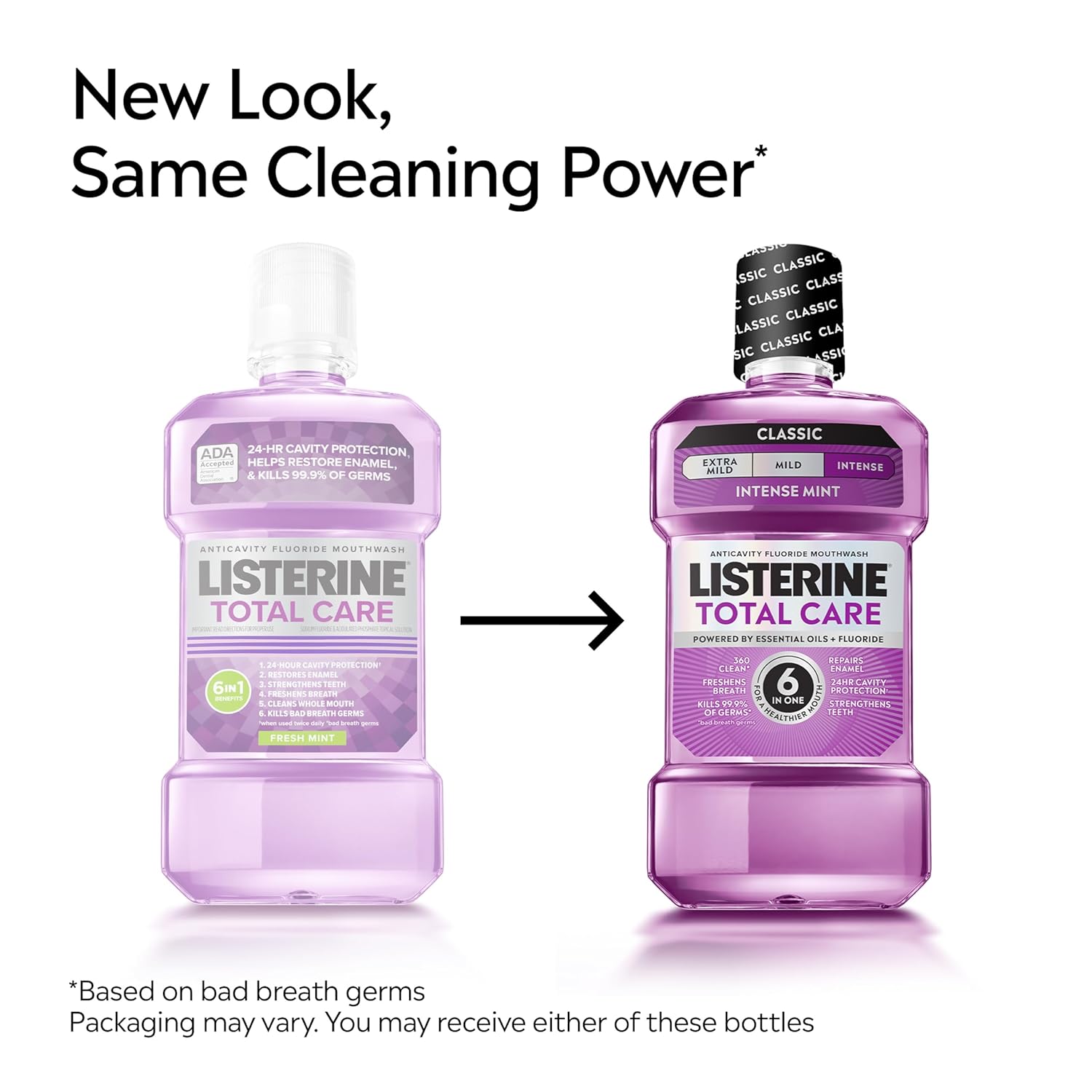
Listerine
$8.98
In stock on Amazon
Check price on AmazonTheraBreath Fresh Breath Oral Rinse
TheraBreath takes a different approach: its active ingredient is stabilized chlorine dioxide (ClO₂), a compound that neutralizes volatile sulfur compounds (VSCs) — the actual molecules responsible for most bad breath — rather than simply killing bacteria broadly. It’s alcohol-free, which means no burn and no drying effect. A systematic review indexed on NCBI PubMed under the title “Chlorine dioxide and oral health” found chlorine dioxide effective at reducing VSC levels in short-term clinical studies. Healthline’s mouthwash overview describes alcohol-free chlorine dioxide rinses as gentler and longer-lasting than alcohol-based rinses specifically for odor control. The Wirecutter / New York Times “The Best Mouthwash” guide similarly notes that for pure breath-freshening efficacy measured over a multi-hour window, alcohol-free chlorine dioxide rinses outperform alcohol-based options — though Listerine leads on documented plaque and gum-disease prevention because of its essential-oil mechanism’s biofilm-disrupting effect.
TheraBreath
$14.97
In stock on Amazon
Check price on AmazonCloSYS Original Unflavored
CloSYS also uses stabilized chlorine dioxide as its core mechanism, making it TheraBreath’s closest functional cousin — but it adds a distinct differentiator: it’s pH-balanced (formulated to match the mouth’s natural acidity range of roughly 6.8–7.4), and the unflavored version contains no flavor additives, artificial dyes, or sulfates. Mayo Clinic’s overview of bad breath diagnosis and treatment (“Bad breath: Diagnosis and treatment,” MayoClinic.org) specifically mentions pH-balanced rinses as appropriate for patients with sensitive mouths or acid-related oral health concerns. CloSYS is frequently cited by dental hygienists for post-procedure care and for patients managing canker sores or pronounced sensitivity. Where TheraBreath is the gentle daily option, CloSYS is the sensitive-mouth specialist.
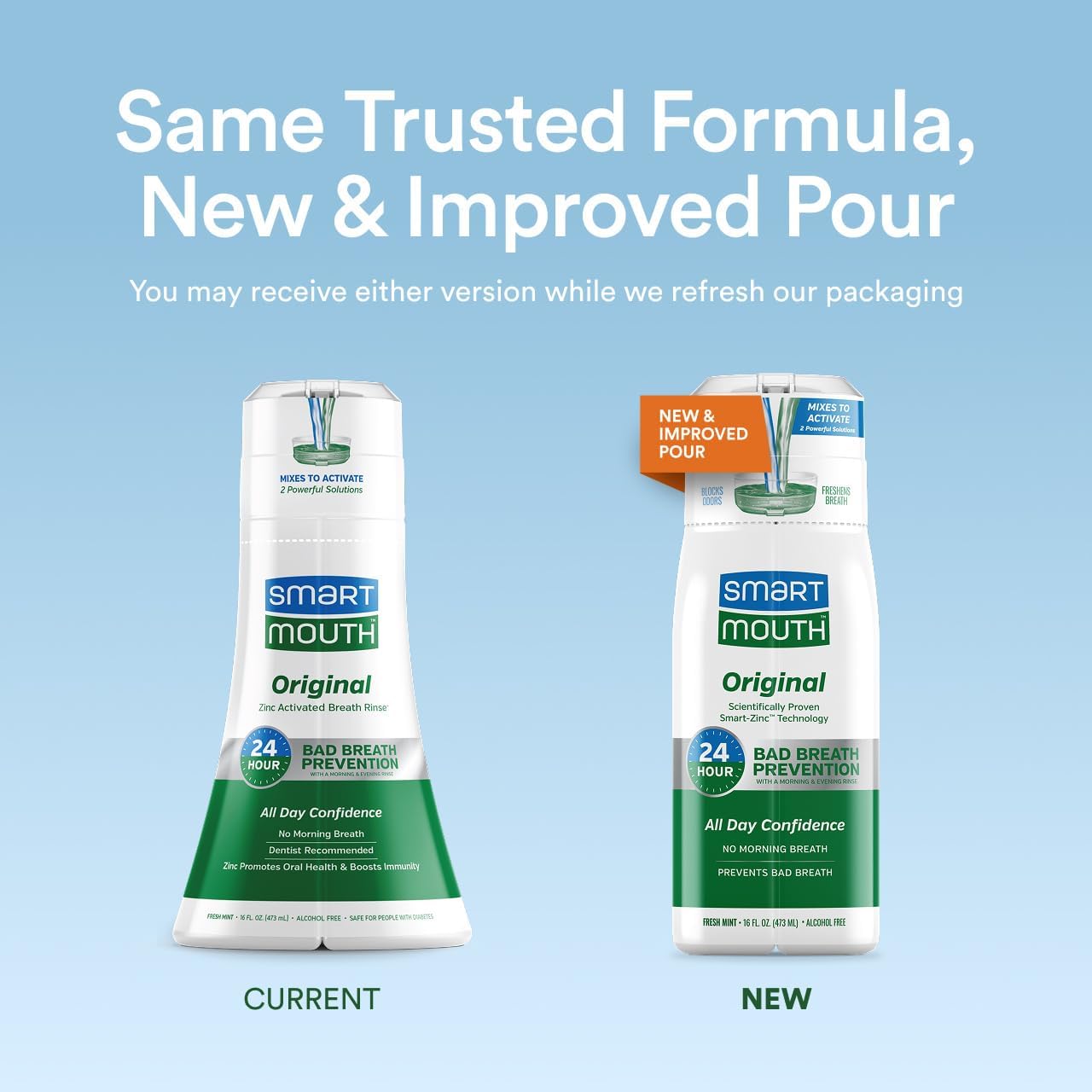
SmartMouth
$19.68
In stock on Amazon
Check price on AmazonThe Price-Per-Use Math (This Is the Part That Changes Everything)
Standard mouthwash dosage is 20 mL per rinse, twice daily, per manufacturer instructions across all three products. Here’s what the actual cost-per-use looks like at widely available retail pricing as of mid-2026:
| Product | Size | Approx. Retail | Uses per Bottle | Cost per Use | Tier |
|---|---|---|---|---|---|
| Listerine Cool Mint 1.5 L | 1,500 mL | ~$9–$11 | 75 | $0.13–$0.15 | Listerine — $8.98 |
| TheraBreath Fresh Breath 33.8 oz | 1,000 mL | ~$14–$17 | 50 | $0.28–$0.34 | TheraBreath — $14.97 |
| CloSYS Original 32 oz | 946 mL | ~$15–$19 | 47 | $0.32–$0.40 | SmartMouth — $19.68 |
At twice-daily use, Listerine costs roughly $9–$11 for 37 days of rinsing. TheraBreath and CloSYS each cover about 23–25 days at the same frequency for $14–$19. Annualized, Listerine runs approximately $90–$110 per year. TheraBreath and CloSYS land at $200–$280 per year — more than double.
That gap is real. But here’s where the framing gets important: if the alcohol in Listerine is irritating your mouth and you’re rinsing only once per day or skipping days, your effective cost-per-use climbs considerably. A $10 bottle that lasts 37 days at full use might stretch to 60 days if irritation causes inconsistency — or it might cause enough dryness to worsen the bacterial environment it’s supposed to address. As Mayo Clinic’s bad-breath treatment overview notes, chronic dry mouth accelerates bacterial growth because saliva’s natural antimicrobial action is reduced. Consistency matters more than the sticker price, and the rinse you’ll actually use every day is always the better buy.
Where Each Product Wins — and Where It Doesn’t
Understanding the cost-per-use table only helps if you match the product to your actual problem. Here’s the honest breakdown.
Listerine is the right choice when:
- Gum health and plaque prevention are your primary concern — the ADA Seal of Acceptance (documented in the American Dental Association’s product acceptance overview) covers this specifically
- You don’t have alcohol sensitivity, dry mouth, or a clinical reason to avoid ethanol
- You’re using it as part of a broader routine that already includes a tongue scraper and floss, so the burn is a known and accepted element of your morning
- Budget is a genuine constraint and you need the lowest reliable cost-per-use
Listerine is the wrong choice when:
- You have chronic dry mouth — per Mayo Clinic’s treatment overview, alcohol accelerates moisture loss and can worsen the underlying bacterial environment
- Burning or irritation has been causing you to skip rinses, which defeats the purpose entirely
- You’re using it as a substitute for brushing rather than a supplement (no mouthwash replaces mechanical cleaning)
TheraBreath is the right choice when:
- Odor is your primary complaint and you want a mechanism (chlorine dioxide targeting VSCs directly) supported by clinical research indexed in NCBI PubMed
- You want an alcohol-free daily rinse with no burn or drying effect
- You’re building a layered breath-care routine and need one component to handle halitosis specifically
- The Wirecutter / New York Times “The Best Mouthwash” guide’s finding — that chlorine dioxide rinses outperform alcohol rinses for multi-hour odor control — aligns with your primary use case
TheraBreath is the wrong choice when:
- You need ADA-documented gum-disease or plaque-reduction outcomes (TheraBreath’s clinical focus is narrower — halitosis specifically, not biofilm disruption)
- You’re price-sensitive and don’t have a persistent breath problem significant enough to justify the premium
CloSYS is the right choice when:
- Sensitivity is a hard constraint — canker sores, post-dental-work healing, acid-reflux-related enamel sensitivity, or a mouth that reacts badly to flavoring agents or dyes
- You want the chlorine dioxide mechanism without any additives — unflavored, undyed, unsweetened
- Your dentist or hygienist has specifically recommended a pH-balanced rinse, as described in Mayo Clinic’s bad-breath treatment guidance
CloSYS is the wrong choice when:
- The complete lack of flavor undermines your habit formation — many users in long-run reviews report struggling with motivation to rinse a product that tastes like nothing
- You want an ADA Seal covering plaque prevention as a documented clinical outcome
Stacking Logic: How to Use More Than One
Here’s the honest answer most buying guides skip: you don’t necessarily have to pick just one.
Healthline’s mouthwash editorial overview implicitly supports a stacking approach — using each product for the specific job it’s best equipped to do rather than asking a single rinse to cover every concern. A practical stack: use a fluoride toothpaste plus mechanical flossing as your non-negotiable foundation, then rinse once daily with whichever product addresses your primary concern. If gum health is the issue, Listerine earns its lower cost. If persistent odor is the issue — especially mid-day or before social situations — a small TheraBreath kept at a desk or in a bag works as a targeted intervention without replacing your primary rinse.
Total cost for a Listerine-morning / TheraBreath-targeted stack, annualized: roughly $130–$160 per year. Still well below a TheraBreath-only twice-daily commitment, and arguably more functional because each product is being used for what it’s actually optimized to do.
If you’re investing in a broader oral-microbiome routine — tongue scraping, oral probiotics, oil pulling — CloSYS fits cleanly into the sensitivity-conscious layer of that system. Its pH-balanced, additive-free formula is gentler on the oral environment you’re trying to cultivate rather than broadly sanitize, which matters if you’re also working to support beneficial bacterial populations rather than eliminate everything indiscriminately.
The Decision Rule
If you’ve read this far, here’s your clear “if X, then Y” framework:
- If your goal is proven gum-disease prevention at the lowest annual cost: Listerine Cool Mint 1.5 L, used consistently, is the answer. The ADA Seal of Acceptance (American Dental Association product acceptance overview) documents this outcome. Accept the burn or use it once daily rather than twice.
- If your goal is reliable, all-day halitosis control without alcohol: TheraBreath Fresh Breath Oral Rinse is the clearest match. The chlorine-dioxide mechanism is supported by research in NCBI PubMed, and Healthline’s editorial overview confirms the gentler daily-use profile.
- If you have a sensitive mouth or a dental provider has flagged pH or additives as concerns: CloSYS Original Unflavored is the narrow-but-correct fit. It costs roughly the same as TheraBreath per use and does a specific job very well, consistent with Mayo Clinic’s guidance on pH-balanced rinses for sensitive patients.
- If you’re not sure what your primary problem is: Start with Listerine for 30 days. If the burn is tolerable and gum health is your main concern, stay there. If odor persists or irritation accumulates, pivot to TheraBreath.
The most expensive mouthwash you can buy is one that sits unused under the sink because it irritates you or fails to solve your actual problem. Match the product to the mechanism, run the price-per-use math against your real usage frequency — not the ideal printed on the label — and the right answer usually becomes obvious.