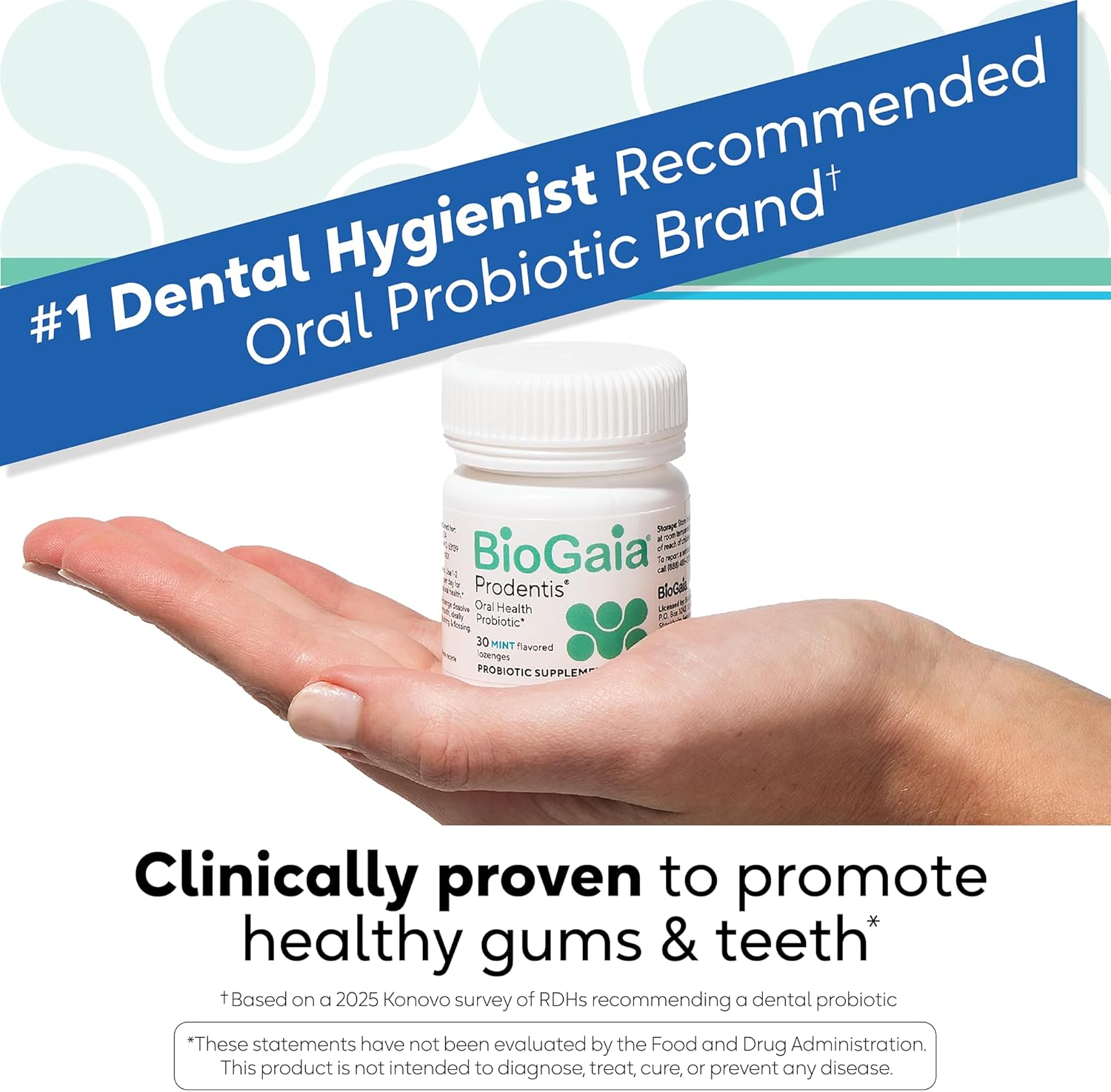
If you’ve ever looked at a box of BioGaia Prodentis lozenges and thought, thirty-something dollars a month just to have better breath and healthier gums — you’re asking exactly the right question. Let’s slow down and figure out whether this one is actually worth it.
An oral probiotic is simply a product that delivers live, beneficial bacteria into your mouth — not your gut — with the goal of crowding out the bacteria that cause bad breath, gum inflammation, and tooth decay. Think of your mouth as a small ecosystem: the bacteria living on your teeth, tongue, and gums are collectively called the oral microbiome. When that ecosystem tips toward harmful species, you get the usual suspects: bleeding gums, persistent odor, and eventually cavities. According to Healthline’s overview of the oral microbiome, this microbial community includes over 700 identified species, and the balance between “good” and “bad” strains matters enormously for both mouth and systemic health.
BioGaia Prodentis is one of the most studied oral probiotic products on the market, built around a specific bacterial strain called Lactobacillus reuteri. This article is going to walk you through what the research actually shows, what it doesn’t show, how the price stacks up, and the clear decision rule for whether to add it to your routine.
What Makes BioGaia Prodentis Different From Generic Probiotics
Most probiotic supplements you find on a pharmacy shelf are formulated for gut health — they’re designed to survive stomach acid, colonize the intestines, and improve digestion. Oral probiotics are a different category entirely. The bacteria need to transiently colonize the oral cavity — meaning they don’t permanently set up shop, but they linger long enough to compete with, and suppress, harmful strains.
BioGaia Prodentis contains two proprietary Lactobacillus reuteri strains: DSM 17938 and ATCC PTA 5289. The dual-strain approach is significant. Published research, including a 2012 study in the Journal of Clinical Periodontology by Iniesta et al., found that these specific strains reduced levels of Porphyromonas gingivalis — a key driver of gum disease — in patients with gingivitis. The strains were specifically selected for oral-tissue adhesion, meaning they’re engineered to stick around the gum line long enough to make an actual impact.
This is the first fork in the road from “generic probiotic” logic. Strain specificity matters. A Lactobacillus acidophilus capsule from the supplement aisle is not a substitute. The clinical data on Prodentis is strain-specific and site-specific (mouth, not gut), and those two facts explain most of the price premium.
A note on delivery format: Prodentis comes as a dissolvable lozenge, not a capsule you swallow. That’s intentional — you let it dissolve slowly so the bacteria make direct contact with the gum tissue, teeth, and tongue. Most users and product reviewers consistently note that the lozenges should be used after brushing, at night, so the bacteria have maximum dwell time without being rinsed away. This timing detail is often buried in the instructions and frequently ignored.
What the Clinical Research Actually Shows (And Where It Gets Complicated)
Here’s where we need to be honest about the state of the evidence, because it’s genuinely mixed — not in the “this doesn’t work” sense, but in the “the effect sizes are real but modest” sense.
The strong signal:
- A 2013 study by Teughels et al., published in the Journal of Clinical Periodontology, found that patients with chronic periodontitis (advanced gum disease) who took L. reuteri lozenges in addition to standard scaling and root planing showed significantly better reductions in probing depth (a clinical measure of gum pocket severity) and bleeding on probing than the control group. The probiotic added meaningful benefit on top of professional treatment.
- Research summarized on Examine.com’s Lactobacillus reuteri reference page consistently shows reductions in gingival inflammation biomarkers with oral L. reuteri use over 4–12 week periods.
- A 2012 review by Twetman and Keller in Advances in Dental Research concluded that probiotic use showed “promising results” for reducing Streptococcus mutans (the bacteria most implicated in cavities), with the strongest evidence coming from L. reuteri and L. rhamnosus strains specifically.
The caveats:
- Study populations are often small (20–60 participants), and many trials run only 4–12 weeks — not enough to confirm long-term colonization or permanent microbiome shifts.
- A 2021 Cochrane systematic review on probiotics for cavity prevention found that while the evidence was promising, trial quality was variable and no definitive conclusions about cavity prevention in healthy adults could be drawn yet. Translation: great for gum health, less conclusive for decay prevention as a standalone benefit.
- These studies almost universally combine probiotics with standard care — brushing, flossing, professional cleaning. There’s no strong evidence that Prodentis compensates for poor brushing habits. It’s a multiplier, not a replacement.
By the Numbers
| Use Case | Evidence Strength | Time to Detectable Effect |
|---|---|---|
| Reducing gum inflammation (gingivitis) | Moderate–Strong | 4–6 weeks |
| Reducing gum pocket depth (periodontitis, adjunct to treatment) | Moderate | 8–12 weeks |
| Reducing cavity-causing bacteria (S. mutans) | Moderate | 4–8 weeks |
| Preventing cavities (standalone, healthy adults) | Weak–Inconclusive | Not established |
| Improving breath (halitosis) | Anecdotal / Indirect | Variable |
The Price Question: Is $30–$45 Per Month Defensible?
Let’s do the actual math, because “expensive” is relative.
A standard box of BioGaia Prodentis contains 30 lozenges, intended for once-daily use. Retail pricing as of mid-2026 typically runs $32–$45 for a 30-count, depending on retailer and whether you subscribe. That puts the per-use cost at roughly $1.07–$1.50 per day.
Compare that to:
- BLIS M18 oral probiotic: Similar price tier, $30–$40/month, different strain targeting S. salivarius and cavity prevention
- Hyperbiotics PRO-Dental: $20–$28/month, broader multi-strain blend, less strain-specific clinical evidence
- Standard mouthwash habit: $0.10–$0.30/day, primarily masking, no microbiome intervention
The honest framing: BioGaia Prodentis is priced as a clinical-grade adjunct, not a convenience product. You’re paying for the specific strain research, the BioGaia patent licensing (the company has been developing L. reuteri applications since the early 1990s and holds significant IP on these strains), and the oral-specific delivery format.
The price is only defensible if:
- You have documented gum issues — gingivitis, bleeding, or a history of periodontitis — and your dentist has already recommended you address your oral microbiome proactively.
- You’re already doing the basics correctly (brushing twice daily, flossing or interdental cleaning, tongue scraping).
- You’re willing to commit to at least 8–12 weeks before evaluating results, because microbiome shifts are not overnight events.
If you’re just looking for fresher breath, a zinc-based lozenge ($10–$18/month, see our zinc vs. chlorine dioxide guide) or an oil-pulling routine costs dramatically less and works through a different, well-documented mechanism. Prodentis is not a breath product at its core — it’s a gum and microbiome product that may improve breath as a downstream effect.
How to Stack Prodentis Into an Existing Oral Routine
Because the practitioner-tier reader is usually thinking in systems, here’s the honest stacking logic:
Prodentis works best as a final step in an evening routine, after you’ve mechanically removed biofilm (brushing + flossing or a water flosser) and after any antimicrobial products like chlorhexidine rinse or CPC (cetylpyridinium chloride — an antimicrobial surfactant used in many clinical mouthwashes) have been used. The sequencing matters: antimicrobials kill bacteria indiscriminately, and using them after your probiotic lozenge wipes out the beneficial strains you just delivered.
The stack that makes sense:
- Brush and floss
- Tongue scrape
- Rinse with antimicrobial mouthwash (if you use one) — wait 15–20 minutes
- Dissolve one Prodentis lozenge slowly, then don’t eat or drink for 30+ minutes
Reviewers who report the strongest results consistently follow this sequencing pattern. The ones who report “nothing happened” often used the lozenge immediately after a CPC or alcohol-based rinse — essentially poisoning the bacteria they just paid $1.25 to deliver.
Reasonable pairings: A copper tongue scraper (Dr. Tung’s or similar) used before the probiotic step removes the bacterial load from the tongue surface, giving the Prodentis strains less competition on initial adhesion. Oil pulling (coconut oil, 10–20 minutes) as a morning habit operates through a different mechanism — mechanical emulsification rather than microbial competition — and doesn’t interfere with an evening Prodentis routine.
The Clear Decision Rule
This is where we cut through the noise:
If you have a current or recent diagnosis of gingivitis or mild-to-moderate periodontitis, are already brushing and flossing consistently, and want a clinically grounded adjunct to your professional care — BioGaia Prodentis is one of the few oral probiotics with strain-specific evidence behind it. The $32–$45/month is defensible as a long-term wellness line item, comparable to a quality electric toothbrush head subscription.
If your oral health is currently solid and your primary concern is breath, the evidence doesn’t support spending $40/month on Prodentis over a well-built zinc + tongue scraping routine at roughly half the cost. Start there, re-evaluate in 60 days.
If you’re deciding between Prodentis and a multi-strain budget probiotic marketed as “oral health support,” the strain specificity of Prodentis wins on research depth every time — but only if gum inflammation is your target outcome. Multi-strain blends have broader theoretical coverage; they have narrower published evidence for the mouth specifically.
The bottom line: BioGaia Prodentis sits at the intersection of genuine clinical research and premium pricing — and for once, the premium is mostly earned. The question isn’t whether it works. It’s whether your current oral health situation is the one the research was studying. If it is, the math works.