You already know bad breath is embarrassing. But if you’ve been rinsing with mouthwash every morning and your breath still falls apart by mid-afternoon, the mouthwash itself may be part of the problem. Here’s the short version: most conventional mouthwashes contain alcohol — the same kind that’s in a glass of wine, just in rinse form. Alcohol is used as a preservative and to create that sharp, “clean” burn that many people associate with effectiveness. The problem is that alcohol is also a desiccant, meaning it dries things out. In your mouth, that means it strips away saliva — and saliva (your mouth’s natural self-cleaning fluid) is the single most important defense against bad breath. Less saliva equals more odor-causing bacteria. More bacteria means worse breath, faster. This article explains the dry-mouth–bad-breath loop, names the specific ingredients that break it, and gives you a clear decision framework for picking the right alcohol-free rinse for your situation.
| EDITOR'S PICK[CloSYS Mouthwash](https://www.amazon.com/dp/B00NENWQF2?tag=greenflower20-20) | Mid-tier[Oxyfresh Lemon Mint Fresh Breat…](https://www.amazon.com/dp/B00KLEFHP8?tag=greenflower20-20) | Budget pick[Biotene Oral Rinse Mouthwash fo…](https://www.amazon.com/dp/B002KAOAZ4?tag=greenflower20-20) | |
|---|---|---|---|
| Size | 32 oz × 2 | 16 oz | 33.8 oz |
| Alcohol free | ✓ | ✓ | — |
| Dry mouth | — | — | ✓ |
| Flavor | Gentle Mint | Lemon Mint | Fresh Mint |
| Price | $22.95 | $15.45 | $10.97 |
| See on Amazon → | See on Amazon → | See on Amazon → |
Why Saliva Is the Real Mouthwash
Before we talk about products, it helps to understand what saliva actually does, because it’s genuinely impressive and most people underestimate it.
Per the National Center for Biotechnology Information’s review “Saliva and Oral Health,” published in the British Dental Journal, saliva performs at least five functions that directly protect your breath: it washes bacteria and food debris away from tooth surfaces, it neutralizes the acidic waste products that bacteria excrete, it contains antimicrobial proteins (like lysozyme and lactoferrin) that inhibit bacterial growth, it remineralizes tooth enamel, and it keeps the oral tissues moist enough to function as a physical barrier. When saliva flow drops — a condition called xerostomia (dry mouth, pronounced zer-oh-STOH-mee-ah) — all five of those functions decline at the same time.
The Mayo Clinic’s overview of dry mouth lists dozens of causes: over 400 common medications (including antihistamines, antidepressants, blood pressure drugs, and decongestants) list dry mouth as a side effect; mouth-breathing during sleep is another major trigger; and aging reduces baseline saliva production even without medication. WebMD’s dry mouth explainer notes that an estimated 10–30% of adults experience chronic xerostomia — meaning it’s not a niche problem.
Here’s where alcohol-based mouthwash enters as an aggravating factor. Even if your dry mouth is medication-induced or sleep-related, rinsing with an ethanol-containing product (most mainstream rinses run 14–27% alcohol by volume) removes the thin protective saliva film that was already struggling to maintain itself. The result is a paradox: you rinsed to get a cleaner mouth, but within 30–60 minutes, the bacterial population rebounds faster than it would have if you’d rinsed with plain water.
The American Dental Association’s consumer guidance on mouthrinse explicitly notes that alcohol-free formulations are preferred for patients with dry mouth, and that the ADA Seal does not require an alcohol-containing formula. That’s a quiet but important signal: the active ingredients that do the actual antibacterial and breath-freshening work are not alcohol itself.
What “Alcohol-Free” Actually Means on a Label — and What to Look for Instead
Switching to an alcohol-free mouthwash doesn’t automatically mean you’re getting something better. “Alcohol-free” is a subtraction, not an addition. The question is what the formula puts in place of the alcohol as its active agent. Here are the main alternatives, with plain-language explanations of what each one does:
Cetylpyridinium chloride (CPC) — a quaternary ammonium compound (a type of synthetic antiseptic) that disrupts the cell membranes of bacteria, killing them without requiring alcohol as a carrier. CPC is the active ingredient in Crest Pro-Health and several store-brand alcohol-free rinses. It’s effective and well-studied, though Healthline’s overview of bad breath treatments notes that CPC can cause temporary tooth staining in some users, particularly at higher concentrations.
Chlorhexidine gluconate (CHX) — the clinical gold standard for antibacterial rinses, available by prescription in the U.S. at 0.12% concentration. CHX bonds to oral surfaces and provides residual antibacterial activity for hours after rinsing. It’s the strongest tool in the lineup, but it comes with meaningful tradeoffs: it stains teeth and tongue with prolonged use, it can alter taste perception, and it’s not meant for daily indefinite use. Healthline and WebMD both flag CHX as appropriate for short-term therapeutic use (post-surgery, severe gum disease management) rather than as a daily breath-freshening rinse.
Zinc compounds (zinc chloride, zinc acetate, zinc gluconate) — zinc ions neutralize volatile sulfur compounds (VSCs), which are the specific molecules that give bad breath its sulfurous, rotten-egg-adjacent character. Zinc doesn’t kill bacteria the way CPC or CHX does; it chemically binds to and deactivates the odor molecules that bacteria produce. This is why zinc is often described as treating the cause of odor rather than masking it. TheraBreath’s clinical rinse line uses zinc gluconate as a core active; the brand has been repeatedly cited by Healthline and Wirecutter-adjacent reviews for this mechanism.
Xylitol — a sugar alcohol (not ethanol — completely different chemistry) derived from plant fibers, xylitol does two things relevant here: it stimulates saliva production, which directly counteracts dry mouth, and it starves certain bacteria (specifically Streptococcus mutans, a cavity-causing species) that cannot metabolize it normally. Xylitol alone is not a strong antibacterial agent, but its saliva-stimulating effect makes it a useful supporting ingredient in alcohol-free rinses aimed at dry-mouth sufferers.
Fluoride — not an antibacterial agent, but relevant because dry mouth dramatically increases cavity risk (saliva’s remineralizing function is impaired). If you have dry mouth, a fluoride-containing alcohol-free rinse addresses two problems at once: bacterial load and enamel vulnerability.
By the Numbers
| Ingredient | Mechanism | Best for | Watch out for |
|---|---|---|---|
| CPC | Kills bacteria (cell membrane disruption) | Daily use, gum health | Possible tooth staining at high doses |
| Zinc gluconate | Neutralizes odor molecules (VSCs) | Sulfur-based bad breath | Works best combined with another active |
| Chlorhexidine (CHX) | Strong residual antibacterial | Short-term clinical use | Staining, taste changes — not for daily indefinite use |
| Xylitol | Stimulates saliva, starves cavity bacteria | Dry mouth support | Not a standalone antibacterial |
| Fluoride | Remineralizes enamel | Dry mouth + cavity risk | No antibacterial effect on its own |
Comparing the Real Tradeoffs: Budget vs. Clinical-Strength Alcohol-Free Options
The alcohol-free rinse market has expanded significantly through 2025–2026, and the price spread now runs from roughly $5 to $25 per bottle. The sticker price tells you almost nothing useful. Here’s the framework that actually matters:
Price-per-use matters more than price-per-bottle. A 1-liter bottle of ACT Total Care Dry Mouth Rinse (alcohol-free, fluoride-containing, typically found at mass-market retailers in the $8–$10 range) yields roughly 60 uses at the standard 20ml dose. That’s under $0.17 per rinse. A 500ml bottle of TheraBreath Healthy Gums Oral Rinse (zinc gluconate plus CPC, typically $12–$16) yields about 25 uses at the same dose — closer to $0.55 per rinse. The TheraBreath formulation is meaningfully stronger for sulfur-compound-driven bad breath; the ACT formulation is a better fit if your primary concern is dry-mouth-related cavity risk alongside breath. Neither is the wrong answer — but they’re answers to different questions.
Masking versus treating — the distinction you actually need. Mint flavor is not an active ingredient. Neither is “freshness.” Across aggregated reviews of conventional alcohol-based rinses (Listerine Cool Mint, for example), the pattern is consistent: users report strong immediate freshness followed by breath that returns to baseline — or worse — within an hour. That rebound is the alcohol-dry-mouth cycle in action. By contrast, owners of zinc-based alcohol-free rinses consistently report that the freshness window extends meaningfully because the underlying VSC chemistry is being addressed, not merely overpowered with peppermint oil.
Sensitive users and medication interactions. If you are among the 10–30% of adults with chronic dry mouth related to medications, the calculus shifts further toward xylitol-enhanced and fluoride-containing alcohol-free rinses. The goal in that population isn’t maximum antibacterial punch — it’s protecting a mouth that already has impaired self-defense mechanisms. Hitting an already-dry oral environment with even a mild astringent (which some CPC rinses can be at higher concentrations) is counterproductive. The Mayo Clinic’s dry mouth guidance specifically recommends saliva-stimulating products (like xylitol rinses) and avoiding anything that further dries oral tissues.
How to Stack an Alcohol-Free Rinse Into an Actual Routine
Buying the right rinse is step one. Using it in a sequence that lets it work is step two — and most people skip this.
Timing matters. Alcohol-free rinses with active antibacterial agents (CPC, zinc) are most effective when used after brushing and flossing, not before. The mechanical action of brushing and flossing physically disrupts the biofilm (the thin layer of bacteria that forms on teeth and gum tissue); the rinse then contacts disrupted, exposed bacteria rather than having to penetrate an intact film.
Don’t rinse with water after. This is the most common mistake across user reviews: rinsing with water immediately after mouthwash dilutes and partially removes the active ingredients before they’ve had time to work. The standard guidance from the ADA and product-specific directions is to spit, not rinse.
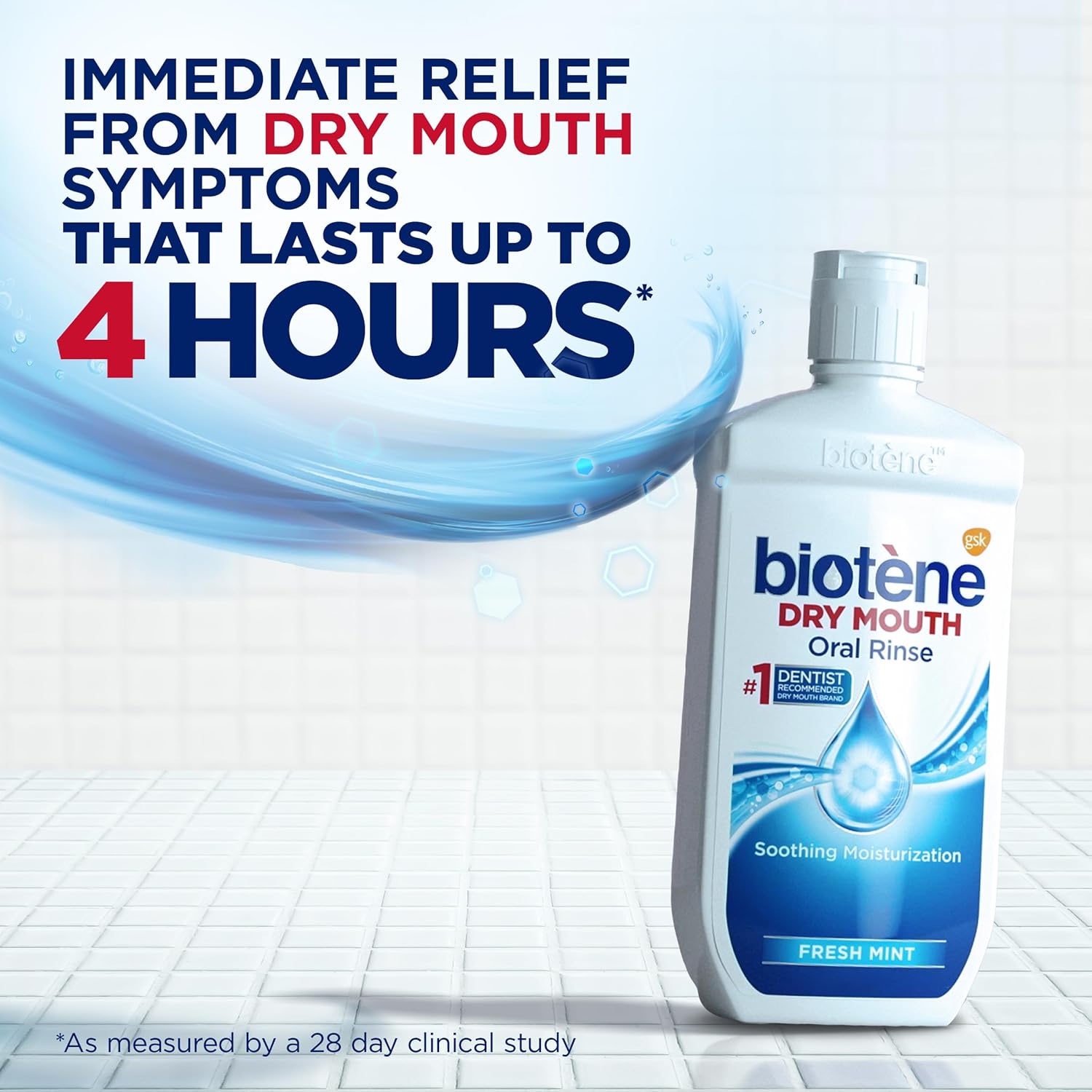
For dry-mouth sufferers specifically: consider a xylitol-based rinse or oral spray mid-day as a saliva stimulant, separate from your morning antibacterial routine. Products like Biotène (a widely available, pharmacist-recommended dry-mouth rinse with xylitol and enzymes that mimic saliva proteins) are designed for this use case and are routinely recommended in WebMD’s dry mouth treatment overview.
The tongue scraper interaction. If you’re using a tongue scraper (which you should be — the tongue dorsum, the top surface, is where the majority of VSC-producing bacteria live), scraping before rinsing gives the zinc or CPC in your rinse direct contact with a disrupted bacterial population rather than an intact film. Reviewers of Dr. Tung’s stainless and copper scrapers consistently report that combining scraping with a zinc-based alcohol-free rinse produces noticeably better results than either tool alone — which aligns with what the underlying chemistry would predict.
The Decision Rule
If you finish reading this and still feel uncertain, here’s the if-then framework:
If your bad breath is primarily sulfur-based (the kind that smells like rotten eggs or something biological, not just stale) → prioritize zinc gluconate as the active ingredient. TheraBreath’s clinical formulations are built specifically for this mechanism and have a consistent track record in aggregated reviews.
If your mouth is chronically dry (waking up parched, medications, mouth-breathing, or simply getting older) → prioritize xylitol and fluoride in an alcohol-free rinse, and consider adding a mid-day xylitol spray. Biotène is the most accessible starting point; pharmacists consistently recommend it in this context.
If you have active gum disease or are post-dental-procedure → chlorhexidine (by prescription) is the appropriate short-term tool. It is not a daily long-term rinse. Talk to your dentist about duration.
If you want one rinse that handles both breath and dry-mouth protection reasonably well → look for a formulation that combines zinc gluconate, xylitol, and fluoride. That combination is less common but exists in the premium tier ($15–$25). The cost-per-use math is higher, but you’re buying a three-mechanism product.
The bottom line is straightforward: alcohol in mouthwash was never doing the antibacterial work — it was just the delivery vehicle and the burn that felt like proof. The ingredients that actually fight bad breath work fine without it. For a dry mouth, removing the alcohol isn’t a compromise. It’s the correction.